Received-
"WELLS FARGO SECURITIES, LLC
ECONOMICS GROUP
Jay H. Bryson, Global Economist
jay.bryson@wellsfargo.com ● (704) 410-3274
Russian Economic Outlook: Light at End of Tunnel-May 05, 2015
Executive Summary
Most indicators suggest that the Russian economy is contracting at present, and further weakness
seems likely in the near term. However, the seeds of an eventual recovery are being sown. The
inflation rate appears to be topping out now that the currency, which came under significant
selling pressure last year, has stabilized. Consequently, the central bank is beginning to ease
monetary policy. Lower inflation will also be good news for real income growth, which should
help to put a floor under consumer spending. The depreciation of the ruble has also improved the
price competitiveness of Russia’s non-energy exports.
Although the Russian economy likely will start growing again next year, the country faces some
significant downside risks related to the global economic outlook and the situation vis-à-vis
Ukraine. Moreover, the economy will struggle to grow at the same robust growth rates that it
enjoyed during the past decade.
Easing of Inflation Gives Central Bank Scope to Ease Policy
The Central Bank of the Russian Federation (CBRF) announced on April 30 that it was reducing
its “key rate,” the interest rate at which it provides liquidity to the banking system, from
14.00 percent to 12.50 percent (Figure 1). The central bank jacked up rates sharply last year as a
number of negative shocks caused the Russian ruble to go into freefall (Figure 2). First, sanctions
imposed by western economies in response to the Russian-Ukrainian crisis led to downward
pressure on the currency. The nosedive in the price of oil, the country’s most important export, in
the second half of last year added to the selling pressure on the ruble
Oil prices have largely stabilized this year, and the ruble has bounced about 30 percent vis-à-vis
the U.S. dollar since hitting bottom in December. This rally in the value of the ruble has given the
CBRF scope to reverse some of its previous tightening. Although the key rate remains high
relative to its level last spring, the central bank has slashed it by 450 bps over the past three
months and most analysts look for further rate cuts in the months ahead.
In its press release announcing the April 30 rate cut, the CBRF cited “lower inflation risks” and
prospects of weak economic growth as reasons to ease monetary policy at this time. Russian CPI
inflation soared in late 2014/early 2015, due largely to the collapse of the ruble, but the rate of
inflation’s increase has slowed significantly during the past two months as the currency has
stabilized (Figure 3). Looking forward, CPI inflation should recede in coming months due to the
combination of currency appreciation and economic weakness, a topic to which we now turn.
The central bank recently cut its main policy rate
Inflation should recede in coming months
Real income had been eroded by the sharp increase in inflation.
Economic Weakness Has Further to Run
The sharp increase in CPI inflation that we discussed above led to an erosion in consumer
purchasing power. Although nominal wages rose at a solid year-over-year rate of 6.5 percent in
the first quarter of 2015, the significant jump in inflation caused real (i.e., inflation adjusted)
wages to fall more than 8 percent. This sharp drop in purchasing power has weighed on growth in
consumer spending. As shown in Figure 4, real retail sales tumbled 8.7 percent on a year-ago
basis in March, the deepest rate of contraction since the global financial crisis in 2008-2009.
Although spending on services by consumers may not have been quite as weak as spending on
goods, overall personal consumption expenditures undoubtedly contracted sharply in the first
quarter.1
The near-term economic outlook is rather dismal. Although real retail spending was off
8.7 percent in March, industrial production was down only 0.6 percent (Figure 4). Unless
investment spending strengthened considerably in the first quarter, which seems highly unlikely
due to the uncertainties at present that surround the economic outlook in Russia, this divergence
between consumer spending and industrial production implies that inventories probably rose
significantly. Therefore, growth in industrial production likely will weaken further in coming
months as manufacturers attempt to pare excess stocks. As shown in Table 1, we look for the yearover-
year rate of real GDP growth, which was 0.4 percent in Q4 2014, to have turned negative in
the first quarter and to remain there throughout the remainder of this year.
Table 1: Russian Forecasts (Year-over-Year Rates)
Q1-15 Q2-15 Q3-15 Q4-15 Q1-16 Q2-16 Q3-16 Q4-16
-3.0 -3.8 -3.5 -3.6 -0.1 0.4 0.7 1.3 GDP Growth
16.2 15.8 15.3 13.1 6.5 5.4 5.4 5.5 CPI Inflation
Source: Wells Fargo Securities, LLC
The good news is that the seeds of an eventual economic recovery in Russia are slowly being sown. The central bank has already slashed its main policy rate by 450 bps so far this year, and further easing appears likely if our forecast of receding CPI inflation comes to pass (Table 1). Lower interest rates should begin to put a floor under interest rate-sensitive spending in Russia. Real income should also stabilize if inflation continues to recede, thereby helping to shore up growth in consumer spending. The real effective value of the Russian ruble dropped 30 percent between July and February. Although the ruble has bounced back a bit recently, the significant increase in the price competitiveness of Russian goods and services should help to bolster growth in the country’s non-energy exports.2 In our view, real GDP growth should return to positive territory early in 2016.
That said, the Russian economy is hardly out of the woods at present, and there are a number of downside risks to keep in mind. First, the Russian economy in its weakened state is susceptible to foreign economic developments at present. Although we look for global GDP to grow roughly 3 percent in 2015, which is equivalent to the global GDP growth rate that was registered last year, the Russian economic outlook would deteriorate if global growth were to stumble for some reason. Not only would slower global growth weigh directly on Russian export growth, but oil prices likely would head lower if global growth were to falter. A renewed decline in petroleum prices could cause the Russian ruble to weaken again. Further monetary easing by the central bank may be delayed, if not reversed, if the ruble were to come under renewed selling pressure.
Second, the Russian-Ukrainian crisis may be largely out of the headlines at present, but the situation is hardly “fixed.” Open hostilities between Ukraine and Russia could lead western countries to slap more sanctions on Russia that could weaken economic growth even further. Until the political situation between Russia and Ukraine improves, the threat of further western sanctions will continue to loom as a downside risk to the Russian economic outlook
Conclusion
Most indicators suggest that economic activity in Russia has weakened in recent months, and the country appears to be staring at its deepest downturn since the 2008-2009 global financial crisis. Not only have western sanctions hurt growth, but the sharp depreciation of the Russian ruble that occurred last year caused inflation to shoot higher, thereby weakening purchasing power and consumer spending. The central bank was forced to raise interest rates significantly in a bid to stabilize the currency and keep inflationary expectations in check. Higher interest rates undoubtedly have weighed on domestic spending and likely will continue to do so, at least in the near term.
Although the economy likely will contract further, the seeds are being sown for an eventual recovery. The central bank is easing policy now that the exchange rate has stabilized and inflation appears to be topping out. Receding inflation and lower interest rates should eventually lead to an upturn in domestic spending, and the depreciation of the ruble has improved the price competitiveness of Russian non-energy exports.
Even after the economy begins to recover, however, Russia probably will struggle to reach the growth rates it achieved in the past decade. The Bloomberg consensus forecast looks for 0.50 percent real GDP growth in 2016 and 1.30 percent in 2017, far below the 7.5 percent per annum rate that the economy averaged between 2003 and 2007. Strained relations with the West will likely hurt foreign direct investment in Russia. In addition, depressed petroleum prices will probably restrain new investment in the country’s oilfields
Non-energy goods account for only one-third of Russia’s total exports, so the boost to real GDP growth from the depreciation of the currency will not be large"
---------------------------------------------------------------------------------------------------------------------
My comment-
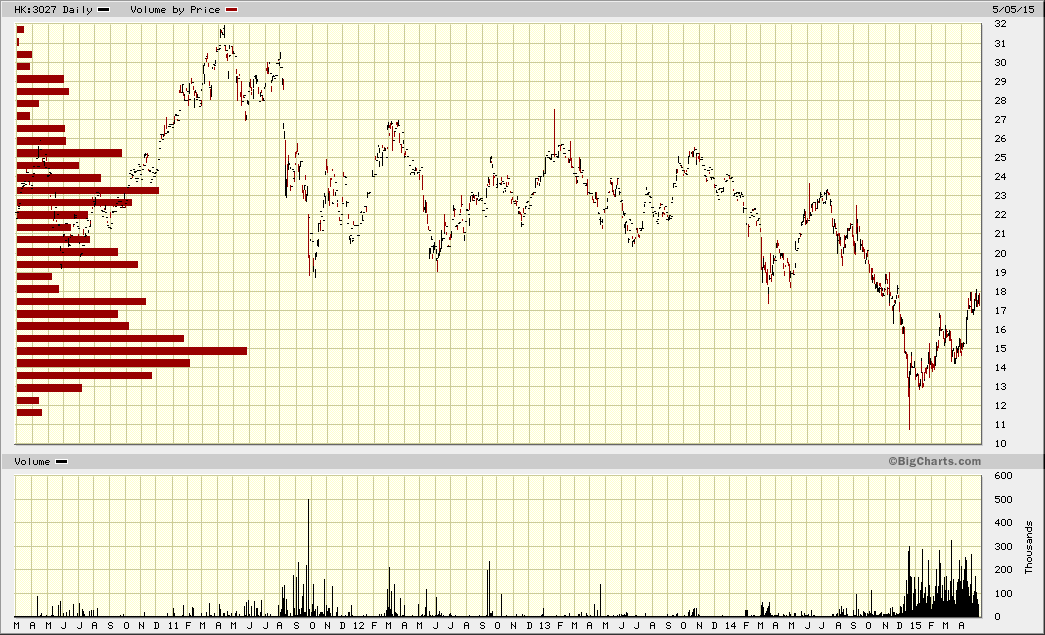
Given such great insights from Well Fargo, the HK-listed Russia ETF 3027 price pattern could be self-explanatory. Note also the RUBCNY
Russian Ruble/Chinese Yuan (CURRENCY) chart

.gif)
.gif)
.gif)

.gif)

.gif) GBPEUR Weekly Chart
GBPEUR Weekly Chart